
Advanced Brass Handle Factories in China: Why They’re Rare
China has a huge hardware industry, but specialist brass handle factories with advanced equipment and direct overseas support remain rare
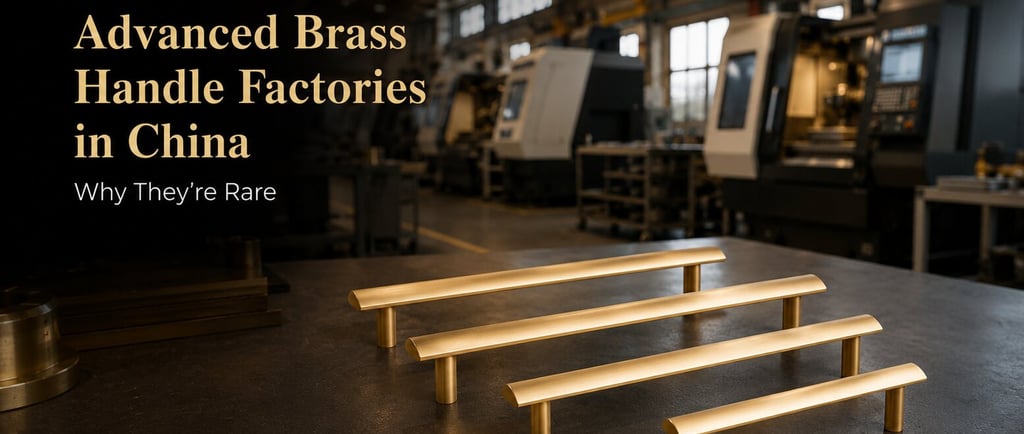
China’s hardware industry is enormous. Yet factories that truly specialise in solid brass handles remain a small group within it.
Across China’s major hardware manufacturing regions, many factories focus on stainless steel, aluminium, zinc alloy, locks, tools, or general furniture fittings. Some also offer brass products, but brass handles are not necessarily the product category around which their equipment, workers, and production standards have been built.
The choice becomes even narrower when an overseas buyer needs more than a standard catalogue model.
The factory may need to understand brass polishing, decorative finishes, product weight, mounting structures, unusual curves, design changes, and small or flexible production runs. It must also be able to explain its manufacturing decisions directly to the customer.
Factories that combine all of these capabilities are still uncommon.
A Large Hardware Industry Does Not Mean Many Brass Specialists
China has several major hardware manufacturing regions, but each area contains a wide mix of products and materials.
A company located in a well-known hardware region may specialise in locks, stainless steel fittings, aluminium parts, zinc-alloy accessories, or general furniture hardware. Its location alone does not prove that it has deep experience in brass handles.
Cross-regional sourcing is also common. Some companies sell brass handles without manufacturing them themselves, while businesses in other hardware regions purchase brass products from factories in Guangdong.
For buyers, this means the supplier’s address is less important than its real product focus and production capability.
Solid brass is not simply another material added to a general hardware catalogue.
The material value is higher, so machining mistakes and unnecessary material removal are more expensive. Polishing directly affects brushed, satin, antique, and high-gloss finishes. Small differences in surface preparation can remain visible after finishing.
The weight, grip, edge details, mounting structure, and colour depth also affect how the finished handle feels.
A general hardware factory may be able to make an occasional brass item. That is different from building long-term experience, equipment, inspection standards, and production routines around brass handles and brass components.
From our day-to-day experience in the industry, fewer than 100 manufacturers in Guangdong appear to treat brass handles as a genuine core product category rather than an occasional product line.
Among the brass handle factories familiar to us, we estimate that around 80% have not yet introduced five-axis machining.
These figures are our own industry estimates, not official census data. We mention them because they reflect a clear reality we see in the market: advanced equipment and specialist brass experience are still concentrated in a relatively small number of factories.
Many traditional factories continue to use older machines because those machines can still produce familiar models for established domestic customers.
When a business mainly depends on fixed designs, repeat orders, domestic showrooms, and price competition, investing heavily in new equipment may not appear urgent.
But overseas brands, designers, and project buyers often ask for something different: unusual proportions, multi-angle structures, detailed textures, shorter development cycles, and more flexibility before committing to a large order.
Traditional machines can continue producing traditional products. Their limitations become more visible when the project itself is no longer traditional.
Why Overseas Buyers Rarely Reach the Manufacturing Team Directly
Most traditional brass hardware factories were not originally built to sell directly to overseas buyers.
Their customers were domestic showrooms, wholesalers, furniture manufacturers, regional distributors, and trading companies. The factory focused on production, while international sales and communication were handled elsewhere.
That structure still shapes the industry today.
Many factories have no English website, no overseas marketing department, and no team responsible for discussing product development directly with international customers.
As a result, trading companies and general export suppliers are often more visible online than the factories actually producing the goods.
Trading companies can provide valuable services. They may source several product categories, manage export procedures, coordinate shipments, and help buyers who need a broad range of items.
The difficulty appears when a project depends on manufacturing judgement rather than simple product sourcing.
An overseas buyer may ask:
· Can this curve be adjusted?
· Why is this area difficult to polish?
· Can the mounting structure be improved?
· Will the colour remain consistent in production?
· Can a new machining method make this design more practical?
When the person speaking to the buyer is several steps away from production, the manufacturing explanation is often reduced to a very simple answer:
“Yes, we can make it.”
Or:
“The factory says it is difficult.”
The buyer receives an answer, but not the reasoning behind it.
The same information loss happens in the opposite direction.
A factory may invest in better equipment, improve a process, or develop a more flexible way to manufacture certain products. But unless the overseas-facing team understands the technical value, the market may never hear about the improvement.
The factory has capability, but the buyer cannot see it.
The buyer has a real market need, but the factory cannot hear it directly.
This gap affects more than communication speed. It also affects product development.
Without direct contact with overseas brands, designers, and project buyers, factories receive less information about international styles, preferred dimensions, installation habits, finish expectations, and the reasons behind a customer’s request.
They continue producing what the domestic market already sells because that is the information available to them.
Over time, manufacturing and overseas market demand become separated.
This is why buyers can find hundreds of similar brass handle listings online, yet still struggle to find a factory that understands a new design and can clearly explain how it should be produced.
What Changes When Manufacturing and Overseas Sales Work Together
Advanced equipment alone does not solve this problem.
An English-speaking sales team alone does not solve it either.
The real improvement happens when manufacturing knowledge and overseas communication work within the same system.
Tongniu’s manufacturing base is in Jiangmen, Guangdong. We focus on brass handles and brass components rather than treating brass as an occasional material option.
We have also upgraded our production capability with five-axis machining.
Five-axis equipment is not necessary for every brass handle, and newer equipment is not automatically the best choice for every product.
Its value is the additional flexibility it gives the manufacturing team when a component contains complex curves, multi-angle details, or machining requirements on several sides.
For certain technically demanding parts, fewer setups and less repeated clamping can make development more practical.
More importantly, our overseas team works directly with the manufacturing team.
When a buyer asks whether a design can be changed, the question reaches the people who understand the material, machines, polishing process, and production risks.
When the manufacturing team identifies a better production route, the overseas team can explain what changes, why it matters, and how it may affect the product.
Customer feedback can move directly into product development. Manufacturing judgement can reach the buyer without being reduced to a simple “yes” or “no.”
For overseas buyers, the value is not merely purchasing directly from a factory.
The real value is being able to understand what the manufacturing source can actually do—and why.
Have a brass handle or brass component project that requires more than a standard catalogue product?
Talk directly with the team involved in its development and production.
Tongniu Brass Handles
© 2026 Tongniu Brass Handles. All rights reserved.
Custom brass handles and matching hardware for global projects.
Products
Company
WhatsApp : +8619820335653
Email: sherry@tongniuhandles.com