
Do Custom Brass Handles Require Tooling? A Practical Guide
Many custom brass handles can be developed from a photo and produced without dedicated tooling. See when CNC machining works and when a mold makes more sense.
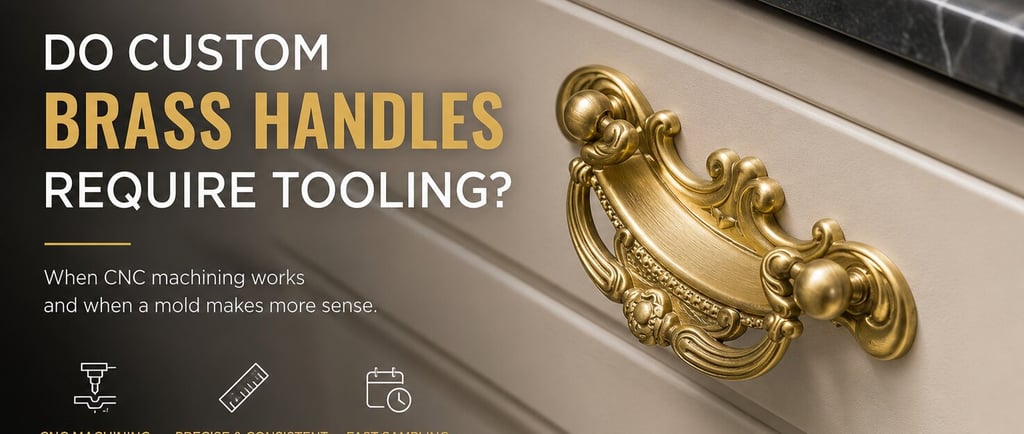
No. Many custom brass handles can be sampled and produced without making a dedicated mold first.
For a new product, this is often the more practical way to begin. The buyer can see and hold a real sample before committing to tooling or a large production order.
This matters because a handle that looks well proportioned in a photo or drawing may feel different once it is installed. The length may need a small adjustment. The projection may be too low. The grip may feel thinner or heavier than expected. Even the finish can change how the final product is perceived.
From a manufacturing point of view, the first sample is often where the design becomes real.
CNC machining gives buyers more room to adjust these details before the product is finalized. However, it does not mean every brass handle should be made without tooling. Some complex shapes and high-volume products are still better suited to forging, casting, or another mold-based process.
The right method depends on the product structure and the expected order quantity.
Many Brass Handles Can Be Made Without Tooling
Regular geometric designs are often suitable for direct CNC production.
Typical examples include bar pulls, T-bar handles, cylindrical handles, knurled pulls, edge pulls, grooved handles, appliance pulls, and certain brass furniture components.
Depending on the structure, the product may be made through CNC turning, milling, drilling, tapping, polishing, and finishing. A dedicated product mold is not always required before the first sample can be produced.
This approach is especially useful for:
· New hardware collections
· Small initial orders
· Showroom samples
· Custom furniture projects
· Market testing
· Products that may still need adjustment
For a new design, flexibility is often more important than achieving the lowest possible unit price immediately.
Dimensions such as the overall length, center-to-center spacing, projection, diameter, and end shape can often be adjusted by updating the drawing and machining program. This is much easier than modifying a completed mold.
CNC is also not limited to making one sample. For suitable structures, it can be used for small-batch and repeat production.
Of course, the decision cannot be made by looking at the front of the handle alone. The back structure, mounting points, curves, internal areas, and available machining access all affect whether direct CNC production is practical.
That is why we first look at the complete design before recommending a production method.
When Does Tooling Make More Sense?
Tooling becomes more practical when the shape is difficult or inefficient to machine directly.
Some decorative brass handles have deep curves, sculptural details, irregular surfaces, or recessed areas. CNC machines may be able to produce them, but the machining time and material waste could make the cost unnecessarily high.
In that situation, casting or forging may be used to form the basic shape. CNC machining can then be used for the mounting holes, threads, and other precision areas.
Tooling may also make more sense when the product has already been tested and will be ordered repeatedly in large quantities.
For example, CNC production may be suitable for the first 50 or 100 pieces. Once the design is confirmed and the order volume grows into the thousands, tooling may improve production efficiency and reduce the long-term unit cost.
This does not mean the original CNC method was wrong.
The production method can change as the product moves from sampling to market testing and then to stable repeat orders.
The goal is not to avoid tooling at all costs. The goal is to avoid paying for it before the product and demand have been confirmed.
Start With a Photo
You do not need a complete technical drawing before contacting us.
A clear product photo, sketch, or reference image is enough to begin.
We can first look at the general shape, proportions, mounting style, and possible manufacturing method. We provide free design support and can help turn the reference image into a workable brass handle design.
The remaining details can be confirmed step by step.
Before sampling, we normally confirm the approximate size, center-to-center spacing, required quantity, and preferred finish. You do not need to prepare all of this before the first conversation.
For many designs that fit our CNC process, a sample can be completed in around seven days after the main details are confirmed.
This gives buyers a simpler way to test a new brass hardware idea before deciding on tooling or a larger order.
Have a brass handle you want to develop?
Send us a reference photo. We will help with the design and evaluate whether it can be produced without dedicated tooling.
Tongniu Brass Handles
© 2026 Tongniu Brass Handles. All rights reserved.
Custom brass handles and matching hardware for global projects.
Products
Company
WhatsApp : +8619820335653
Email: sherry@tongniuhandles.com